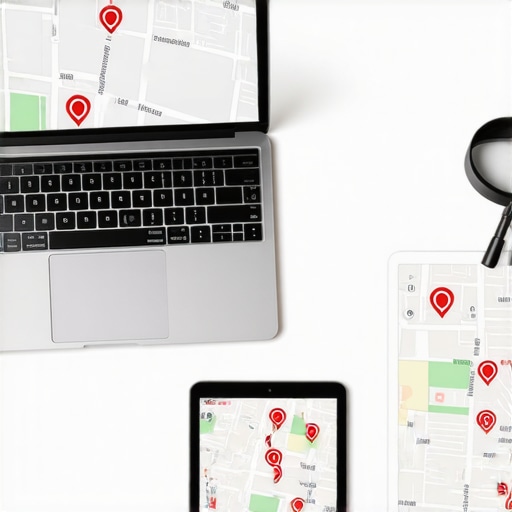
The smell of wet concrete always reminds me of a failed verification attempt. I was standing on a sidewalk in downtown Chicago, holding a utility bill and a smartphone, trying to prove to a support bot that a plumbing business actually existed behind a nondescript gray door. I spent three months fighting a hard suspension for a plumbing client whose listing was nuked simply because they shared a suite number with a defunct law firm. Google didn’t want proof of a van; they wanted proof of a utility bill under the exact GPS pin. This is the reality of the hyper-local layer. It is not about pretty pictures or clever taglines; it is about the cold, mathematical salience of spatial data. When you look at a Map Pack, you are looking at a living grid of proximity beacons. If one signal flickers, the entire visibility structure collapses. This is why I treat every audit like a forensic crime scene, looking for the tiny digital glitches that signal a trust violation to the algorithm.
The ghost in the GPS coordinates
GPS coordinates are the primary anchors of local trust in the modern search environment. Every business listing exists as a specific latitude and longitude point within a massive spatial database that prioritizes physical proximity over almost every other ranking factor. If your coordinates are even slightly off, or if they overlap with a high-risk entity, the system triggers a proximity filter that can hide your profile from users only two blocks away. I have seen businesses lose 80 percent of their traffic because a road construction project changed the way the Google car mapped their entrance. When we talk about the best software to rank in google maps 3 pack, we are really talking about tools that can verify the integrity of these geo-spatial signals. You need to understand how your pin sits in relation to the centroid of the city. The closer you are to the dense cluster of search intent, the more pressure there is on your verification data. If you are using best gmb ranking tools for local seo, you must look beyond simple keyword tracking and analyze the actual grid of proximity. The algorithm treats distance as a weighted signal. Relevance is secondary to the physical location of the user’s mobile device at the moment of the query.
“Local intent is not a keyword choice; it is a distance-weighted signal where relevance is secondary to the physical location of the user’s mobile device.” – Map Search Fundamental
Why your physical address is a liability
Address data serves as the foundation for the Knowledge Graph’s understanding of your business entity. Any deviation in how your address is formatted across the web creates a friction point that lowers your overall trust score with the proximity engine. Many owners do not realize that a single comma or an abbreviated ‘Ste’ versus ‘Suite’ can cause a algorithmic mismatch. When we provide services to fix mismatched business address and phone number, we are performing a deep cleaning of the business’s digital footprint. We look for historic data shards from previous tenants or old business names that might still be clinging to your physical coordinates. This is especially vital when you are trying to how to use tools to rank your google business profile effectively. Most automated systems will miss these legacy errors. You need a human eye to spot why a 2014 citation from a dead directory is still confusing the Google bot. The best toolkit to improve local search rankings must include a manual audit component that tracks down these ‘ghost’ addresses. If your NAP (Name, Address, Phone) data is inconsistent, the algorithm will hedge its bets by ranking a competitor with a cleaner data set, even if that competitor has fewer reviews. You should read about why mismatched contact details are a massive trust red flag for google to understand the severity of this issue.
Local Authority Reading List
- The Agency Stack Tools We Use to Manage Google Business Profiles at Scale
- Why Quality Citations Still Matter More than any Automated Tool
- The 10 Minute Fix for Local SEO Errors that Keep Your Pin Hidden
- The Exact Appeal Letter That Reverses a Profile Suspension Fast
- The Ranking Factors That Actually Matter After a Google Map Update
The three mile radius that determines your revenue
Proximity radius shifts are the leading cause of sudden ranking drops for established local brands. Google constantly adjusts the ‘zoom level’ of the local pack based on the category of the business and the density of competitors. For a locksmith, the radius might be extremely tight, while for a specialized surgical center, it might extend twenty miles. If you find yourself needing local seo services to recover from proximity based ranking drop, you are likely a victim of a ‘Vicinity’ update. These updates are designed to stop businesses from dominating large areas from a single physical point. To combat this, you need to prove local relevance through behavioral signals. This means getting reviews from people who are physically standing within your target service area. The local seo services to stabilize volatile map rankings after expansion focus on building these ‘geo-signals’ through localized content and map embeds that actually validate your service radius. While most agencies suggest more keywords, the real winning move is often found in the metadata of the photos your customers upload. If a customer takes a photo at your shop and their GPS is enabled, that is a 100 percent verified proximity signal that no software can fake. This is one of those local profile seo hacks to elevate your google business profile that actually moves the needle in 2025. You must stop thinking about rankings and start thinking about spatial validation.
How to audit GMB profile with a toolkit
Auditing a profile requires a multi-layered approach that examines both the frontend visibility and the backend entity health. I start by looking at the category choices. If you have selected too many categories, you are diluting your primary signal. This is a common error that many seo services to remove google manual action have to fix first. Then, we move to the anchor text of your internal and external links. If you are using services to fix over optimized anchor text, you are trying to make your link profile look natural to a system that is increasingly suspicious of ‘SEO-friendly’ phrasing. A real business gets links that say ‘click here’ or use the brand name, not ‘best plumber in Chicago.’ When you learn how to audit gmb profile with a toolkit, you are looking for these patterns of over-optimization. You want to see how your listing responds when you change a single variable, like a service area polygon or a profile post. If you are looking for a ultimate gbp ranking checklist for local visibility, you should ensure it includes a section on entity validation. I often find that the biggest ranking gaps are not in the keywords, but in the lack of ‘LocalBusiness’ schema on the linked website. You need to use the best software to rank in google maps 3 pack to identify these technical holes. If the website says one thing and the profile says another, Google will choose the safer option; and that usually means hiding your listing from the top results. Don’t be fooled by buying your first set of local seo tools avoid these expensive traps by focusing on tools that provide raw data rather than just ‘optimization scores.’
“Local search is a trust-based ecosystem where the most consistent data wins, not the most optimized content.” – Spatial Search Weekly
The forensic trace of a service area polygon
Service area businesses face a unique set of challenges because they lack a public-facing physical storefront. For these businesses, Google relies heavily on the ‘Service Area’ settings and the geographic consistency of their web presence. If you set your service area too wide, you risk being flagged for ‘map spam.’ I once audited a carpet cleaner who claimed the entire state of Florida from a small office in Tampa. Their rankings were non-existent because the algorithm knew it was physically impossible for them to service that area effectively. This is where local seo services to stabilize volatile map rankings after expansion come into play. We help businesses define realistic polygons that align with their actual dispatch data. You should also be careful with why most local seo software fails to improve your actual map rankings; many of these tools don’t account for the ‘physical logistics’ of the business. They just see keywords. To truly dominate, you need to connect your GBP to the actual locations of your jobs. This is done through localized landing pages and review request scripts that encourage customers to mention their neighborhood. If you want to know how to force a faster rank on google maps when your profile stalls, start by narrowing your focus to a three-mile radius and winning that first. The best toolkit to improve local search rankings is the one that tells you exactly where you are losing trust in the neighborhood, not just where you are ranking on a global scale. Stop chasing impressions and start fixing your conversion data by looking at the map insight metric you are ignoring that predicts future leads. The future of local search is not about being everywhere; it is about being undeniably present in the places that matter most to your bottom line. Use how to use tools to rank your google business profile as a way to verify your physical reality, not to create a fake one.