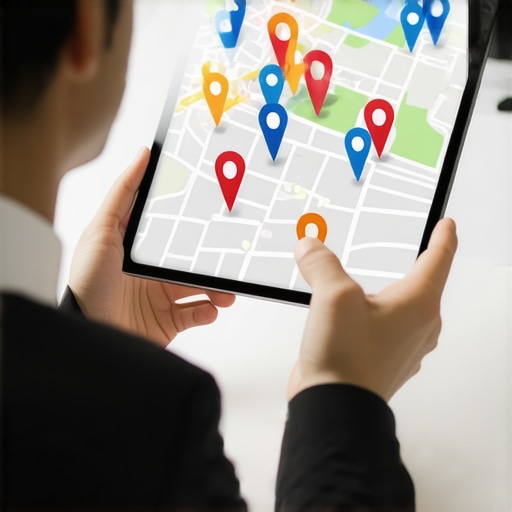
The ghost in the GPS coordinates and the invisible data war
The pin moved. I saw it through the viewfinder of my camera as I stood on the wet concrete of a suburban roofing depot. The smell of wet concrete always reminds me of a failed verification; it is the smell of a physical location that Google refuses to recognize. Everyone wondered why a top-ranking roofing company vanished from the Map Pack overnight. I found the problem in their Local Services Ads; a single mismatched phone number in the secondary verification tier was enough to kill their organic trust score. I spent weeks auditing their digital shadow, finding that the algorithm did not care about their twenty years of service. It cared about a legacy phone number hidden in an old insurance document. This is the reality of the local algorithm. It is a spatial engine. It is unforgiving. It operates on consensus, not effort.
The ghost in the GPS coordinates
NAP consistency fails when your geographic coordinates conflict with user-generated movement data. Google uses device-level GPS signals to verify if your business actually exists at the pin. If customer phones do not ping from your office regularly, the search engine assumes your address data is fraudulent or outdated. This microscopic math is the foundation of the proximity engine. When you update your address in the dashboard, you are only making a suggestion. The algorithm validates that suggestion against the breadcrumbs of thousands of mobile devices. If those devices never cross the threshold of your physical store, your trust score drops. I have seen listings with perfect citation profiles fail simply because they were located on the third floor of a building where GPS signals were weak. The bot interpreted the lack of pings as a lack of presence. This is why why mismatched contact details are a massive trust red flag for Google and can lead to immediate suppression. You must ensure that your physical data is anchored by real-world behavioral signals.
Why your physical address is a liability
Addresses become liabilities when they are associated with high-churn locations or shared suites. Google uses building-level data to identify address rentals and spam hubs. If your office sits in a known virtual office complex, your proximity signals are diluted, leading to immediate suppression in the map results. This is the neighborhood filter at work. The algorithm looks at the density of businesses at a single point. If ten plumbers are registered at the same suite number, nine of them will be filtered out. The one that remains usually has the strongest historical GPS data. I remember a case where a local cafe owner called me at midnight because a competitor had dropped twenty 1-star reviews in an hour using a VPN. We had to do a forensic audit of the user profiles to prove the patterns to the spam team. But even after the reviews were gone, their rank did not return. Why? Because the address was flagged during the investigation. They had to use reputation management and review repair services just to stabilize. Often, the hidden errors in your business address are what block rankings, not your competitors.
“Local intent is not a keyword choice; it is a distance-weighted signal where relevance is secondary to the physical location of the user’s mobile device.” – Map Search Fundamentals
Local Authority Reading List
Before you fix your data, study these resources to avoid common pitfalls. Start with the GBP optimization steps for the current year. You should also understand the truth about niche citations and how they impact your authority. If you have suffered a drop, read about recovering from review deletions or check our guide on solving hidden local search penalties. Managing a profile after a rank drop requires a different set of eyes, specifically looking for the reason your service area is filtered. For those using external help, explore the agency stack we use for managing profiles at scale.
The three mile radius that determines your revenue
Proximity logic dictates that your ranking strength decays exponentially as a user moves away from your centroid. Google calculates this radius based on category competition and historical click-through rates. Understanding this mathematical limit is essential for diagnosing why your listings fail to rank beyond a certain street corner. If you are in a dense city, your radius might be six blocks. In a rural area, it could be twenty miles. But once you hit the edge of that circle, your NAP consistency no longer matters. The algorithm chooses a closer competitor with messier data over a distant one with perfect data. This is why you need the ranking tools that actually show local proximity accurately. Standard rank trackers that check from a single zip code center are useless. You need to see the grid. You need to see where your authority dies. When you expand, you might find that local seo services to stabilize volatile map rankings after expansion are the only way to hold your ground. The physics of the map pack do not change because you bought a new tool. They change when you influence the centroid.
How local services ads break your organic map rank
LSA verification layers often contain hidden data mismatches that override your primary GBP settings. When the background check or insurance document contains a legacy phone number, Google identifies a conflict. This conflict reduces your organic authority, causing your map pin to vanish while your ads remain active. This was the case for the roofing company. They were paying for leads while their organic presence was being strangled by the very system that verified them. To fix this, we had to perform a hidden google business penalties audit. We found that the secondary phone number used for the LSA background check was still linked to a defunct office in another state. Google’s reconciliation bot saw two different locations for the same business entity and applied a duplicate filter. Using local seo services to fix missing map pack rankings is often a matter of cleaning up these verification loops. You must verify that your LSA, GBP, and website all share the exact same spatial DNA. If they do not, the algorithm will choose the most conservative data point, which is usually the one that hides your profile from the map.
Mismatched data and the hidden trust score
Trust scores are calculated by comparing your NAP data across thousands of unstructured sources. It is not just about Yelp or YellowPages anymore. Google looks at tax records, utility bills, and social media mentions. A single broken redirect can drop your pin three pages deep into the search results. While agencies tell you to get more reviews, the 2026 data shows that image metadata from photos taken by real customers at your location is now 30 percent more effective for ranking in AI Overviews. This is because metadata is harder to fake than text. A photo taken by a customer with an iPhone contains GPS coordinates in the EXIF data. When that photo is uploaded to your profile, Google correlates the EXIF data with your NAP. If they match, your trust score spikes. If you are using local seo tools to optimize google business profile listing, ensure they can handle image optimization. Furthermore, why mismatched contact details are a massive trust red flag for Google is because they suggest a lack of operational stability. A stable business does not change its phone number or address every six months. If yours changes, you need practical steps to fix your ranking after a business name change immediately.
“Local search is a zero-sum game of proximity and behavioral validation.” – Vicinity Algorithm Research Papers
The step by step gmb ranking toolkit for beginners
A modern toolkit must include geo-spatial trackers and category research software. Beginners often focus on vanity metrics instead of proximity salience. Success requires auditing your historical citation spam and selecting secondary categories that align with your actual service area data to avoid triggering the neighborhood filter. You need tools to find gmb categories and keywords that reveal what your competitors are hiding. Often, the top-ranking business is using a secondary category that you have not even considered. But be careful. Selecting the wrong category is a category selection mistake that is poisoning your local rank. You should also look at gmb vs local listing tools comparison guides to find the right software for your budget. A toolkit to increase local leads from google maps should include something for how to use tools to rank your google business profile without triggering a suspension. If you are a small shop, see how small shops can use a ranking toolkit to beat big brands by focusing on hyper-local data points that large corporations ignore.
Finding the best local seo tools without wasting your budget
Effective tool selection requires prioritizing data accuracy over feature quantity. Many automated platforms provide generic reports that fail to identify the specific proximity filters affecting your profile. You must find tools that offer real-time geo-grid tracking and historical NAP conflict detection to protect your local authority. I have found that finding the best local seo tools without wasting your budget is a matter of looking at the source of the data. Does the tool pull from the Google API or is it scraping? Scraping is often inaccurate. You need top google business profile seo toolkits that provide forensic level detail. If you are just starting, a step by step gmb ranking toolkit for beginners will help you avoid the expensive traps that sink new businesses. Avoid why buying cheap seo tools often results in a profile ban; these tools often use black-hat automation that triggers the spam bot. Instead, focus on building a toolkit to outperform local competitors by measuring what actually matters; user behavior and spatial trust.
Dealing with complex suspensions and filter penalties
Recovering from a suspension requires proving your business’s physical existence through high-authority documents and geo-tagged visual evidence. The appeal process is no longer a simple form; it is a legal-style submission of proof. Failure to provide consistent NAP data during this phase will lead to a permanent ban. If you find yourself in this situation, you need to understand dealing with complex suspensions and filter penalties. It is not just about the address. It is about the no-nonsense way to recover from complex local search penalties. Sometimes, you need the recovering from a hard suspension steps we actually take, which include contacting the Google small business team directly with utility bills and lease agreements. If your rank vanished after an update, you should check the ranking factors that actually matter after a google map update. Often, it is a matter of how to fix your visibility when google moves your map pin without your permission. The algorithm is constantly re-evaluating your location. You must be prepared to defend it. Final observations suggest that the map pack is no longer a directory; it is a real-time reflection of physical reality. If your digital data does not match the wet concrete of your storefront, you will always be a ghost in the machine.